
Architecture & Engineering Virtual Assistant: The Complete Hiring Guide for AEC Firms
Your best architects are redlining drawings at midnight. Your engineers are chasing RFIs instead of solving structural problems. Your project coordinator is buried in permit applications while a $2M contract sits unproposed in the inbox.
This is the AEC staffing trap: the technical talent you hired to design and engineer ends up running the administrative and production machinery that surrounds those tasks. It's expensive, demoralizing, and entirely preventable.
Filipino architecture and engineering virtual assistants — properly recruited through a structured skills-testing process — can handle your CAD drafting, Revit modeling, BIM coordination, tender documentation, project scheduling, client communication, and back-office operations at up to 80% less than local hiring. This guide covers exactly what they do, what they cost, how to vet them, and how VA Masters sources and places AEC-skilled VAs that pass real technical skills tests before you ever meet them.
Two Types of Architecture & Engineering Virtual Assistants
The most important distinction when hiring for an AEC firm: there are two fundamentally different types of virtual assistant, and confusing them is the most common — and most expensive — mistake firms make.
| Type | Profile | What They Handle | Pricing Range |
|---|---|---|---|
| Technical / Production VA | Trained architect or engineer; proficient in AutoCAD, Revit, SketchUp, Civil 3D | CAD drafting, Revit modeling, BIM coordination, redline implementation, 3D rendering, MEP layouts, construction documentation | $10–$15/hr |
| Operations / Admin VA | Project coordinator or admin professional; understands AEC workflows | RFI management, submittal tracking, permit applications, project scheduling, client communication, invoicing, bid preparation admin, document control | $8–$12/hr |
Most AEC firms need both. A single senior architect or project engineer shouldn't be both drawing in AutoCAD and chasing a building permit approval. When you separate production support from operations support, your licensed professionals can finally focus on what they were trained for — and what you hired them to do.
The Real Bottleneck
Studies consistently show that architects and engineers spend 30–50% of their billable time on tasks that don't require their license or technical judgment: updating drawings from marked-up redlines, preparing submittal packages, tracking RFI status, scheduling meetings, and writing client emails. A virtual assistant handles that 30–50%. Your licensed staff regain that time for design, engineering, and business development.
Technical Tasks: What an Architecture & Engineering VA Actually Produces
Filipino architecture and engineering VAs are not general-purpose assistants who happen to know CAD. Many hold degrees in architecture, civil engineering, or related disciplines from Philippine universities — programs internationally recognized for producing technically rigorous graduates fluent in AutoCAD, Revit, and industry-standard workflows.
Here is a comprehensive breakdown of what technical AEC VAs can deliver:
AutoCAD Drafting & Construction Documentation
Producing complete construction document sets in AutoCAD: floor plans, elevations, building sections, wall sections, and details following your office standards. Implementing redlines and revisions from markups without losing dimension accuracy, layer conventions, or annotation standards. Updating drawing sets when design changes occur — handling the tedious but precision-critical work of propagating changes through sheets. Coordinating backgrounds and maintaining proper xref structure so files stay manageable across project phases.
Revit Modeling & BIM Coordination
Building architectural models in Revit with properly configured families, parameters, and level structure. Creating structural or MEP models to your discipline standards. Coordinating between linked models to identify clashes early — before they become change orders on-site. Managing phasing, worksets, and collaboration workflows in environments using BIM 360 or Autodesk Construction Cloud. Generating schedules, sheet sets, and documentation directly from models. Maintaining model health so files stay stable and performant as the project grows.
MEP Drafting Support
For MEP engineering firms, VAs can handle production drafting for HVAC layout plans (duct routing, diffuser placement, equipment schedules), electrical plans (panel schedules, circuiting, riser diagrams), and plumbing/piping layouts. Working in Revit MEP or AutoCAD MEP to produce coordination-ready drawings while your licensed engineers focus on system design, load calculations, and engineering judgment.
3D Modeling, Rendering & Visualization
Creating design development models in SketchUp, Rhino, or Revit for client presentations. Producing photorealistic renderings using V-Ray, Lumion, or Enscape from your existing model data. Preparing design option studies showing massing, material selections, or configuration variations — the kind of presentation work that wins client approvals but takes senior staff hours to produce.
Virtual Construction Drafting
Translating sketches and schematic designs into buildable, dimensioned drafts. Updating existing drawing sets from field markups (as-builts). Producing shop drawing coordination sets. Handling the repetitive but critical drawing production work that keeps projects moving through permitting and construction phases.
BIM 360 & Document Control
Organizing project files within BIM 360, Autodesk Construction Cloud, Procore, or your firm's document management system. Maintaining drawing issue logs, tracking revision history, and ensuring the correct drawing versions are transmitted to contractors and consultants. Eliminating the coordination failures that stem from version control chaos.
See How We Recruit and Test Technical VA Candidates
Administrative & Operations Tasks for Architecture and Engineering Firms
The operations side of an AEC firm — the work that surrounds design and engineering — generates a relentless volume of coordination, communication, and documentation tasks. A dedicated operations VA for your architecture or engineering firm can own all of this:
RFI & Submittal Management
Logging, tracking, and following up on Requests for Information and submittals across active projects. Maintaining submittal registers, tracking response deadlines, and issuing reminders when consultants or contractors fall behind. Preparing RFI packages from markup information provided by your engineers. In firms using Procore, Buildertrend, or Fieldwire, the VA manages these workflows within your existing software.
Permit Application Support
Preparing permit application packages: compiling drawing sets, completing application forms, coordinating project data for submissions, and tracking application status through municipal review portals. Following up with building departments. Managing the documentation requirements that differ by jurisdiction — work that is procedurally intensive but technically mechanical.
Bid & Proposal Preparation
Researching and identifying relevant tenders and RFPs aligned with your firm's expertise. Reviewing bid documents and compiling required submission materials. Drafting executive summaries, project narratives, and qualification statements based on your firm's project history. Coordinating with consultants to assemble consultant fee proposals. Managing submission deadlines and upload portals. This is work that wins projects — and that most firms do reactively, at the last minute, because no one owns the process.
Project Scheduling & Coordination
Maintaining project schedules in tools like Asana, Monday.com, or MS Project. Tracking milestone deliverables, issuing deadline reminders to internal and external team members, and updating schedules as changes occur. Coordinating meetings between project teams, consultants, contractors, and clients — including agenda preparation, meeting minutes, and action item tracking.
Client & Consultant Communication
Drafting and managing correspondence with clients, reviewing agencies, and consultants. Preparing meeting summaries and transmittals. Following up on outstanding information requests. Managing the communication flow that keeps projects moving without requiring your architects or engineers to spend their day on email.
Financial Administration
Preparing invoices against fee schedules, tracking accounts receivable, processing expenses, and reconciling project budgets. Coordinating with consultants on sub-invoices. Maintaining project cost records in QuickBooks, Xero, or your firm's accounting software. The financial administration work in a project-based business is continuous — and a VA handles it without the overhead of an in-house bookkeeper.
Marketing & Business Development Support
Maintaining your firm's portfolio with updated project photography, descriptions, and metrics. Managing your website, social media presence, and LinkedIn activity. Researching prospects and compiling contact lists for business development outreach. Preparing award submissions and certification applications that build your firm's profile.
What Architecture Firms Underestimate
The most time-consuming administrative work in an architecture or engineering firm isn't the obvious stuff (invoicing, scheduling) — it's the coordination overhead: RFI follow-up, submittal chasing, consultant coordination, and permit status tracking. These tasks are collectively consuming 15–20 hours per week of senior staff time in most firms. That's the first thing a well-briefed operations VA eliminates.
Software Stack: What Filipino AEC VAs Know
Filipino architecture and engineering graduates come through programs that teach industry-standard software from the first year. This isn't a situation where you're training someone from scratch. They know these tools:
| Category | Software | Typical Use |
|---|---|---|
| CAD Drafting | AutoCAD, AutoCAD LT, AutoCAD Architecture, Civil 3D | Construction documents, site plans, civil drawings, as-builts |
| BIM / Modeling | Revit Architecture, Revit Structure, Revit MEP, Navisworks | BIM models, coordination, clash detection, schedules, documentation |
| 3D & Visualization | SketchUp, Rhino, Lumion, V-Ray, Enscape, 3ds Max | Design models, renderings, client presentations, walkthroughs |
| MEP-Specific | AutoCAD MEP, Revit MEP, HAP, Trace 700 | Mechanical, electrical, plumbing layout drafting and documentation |
| Project Management | Procore, Buildertrend, Asana, Monday.com, Primavera P6, MS Project | RFI/submittal management, scheduling, task tracking, project coordination |
| Cloud Collaboration | BIM 360, Autodesk Construction Cloud, Bluebeam Revu, Dropbox, Google Drive | Document control, model sharing, redline coordination, version management |
| Design Graphics | Adobe InDesign, Photoshop, Illustrator | Presentation boards, project sheets, bid documents, marketing collateral |
| Finance & Admin | QuickBooks, Xero, Microsoft Office, Google Workspace | Invoicing, project cost tracking, correspondence, scheduling |
When we recruit for an architecture or engineering VA role at VA Masters, we match based on your specific software stack. If you use Revit + BIM 360 + Procore, we find candidates with verified experience across those exact tools. The custom skills test we build for each role includes practical tasks in the software you actually use — not theoretical questions about it.
Cost Comparison: Architecture & Engineering VA vs. Every Alternative
Let's be direct about the numbers. AEC firms have several options for getting production and administrative support. Here's what each actually costs:
| Staffing Option | Annual Cost | Commitment | Key Limitation |
|---|---|---|---|
| Junior Architect (US) | $60,000–$85,000 + benefits | Full-time employment | Licensed professional doing drafting work |
| CAD Technician (US) | $50,000–$70,000 + benefits | Full-time employment | Limited to production; no design judgment |
| Project Coordinator (US) | $55,000–$75,000 + benefits | Full-time employment | Office-based overhead required |
| Freelance Drafter | $40–$100/hr (project-based) | Per project | No continuity; availability not guaranteed |
| AEC-Specific Agency (e.g. Remote AE) | $2,000–$4,000+/mo retainer | Ongoing | Premium pricing; niche-only offering |
| Filipino AEC VA — VA Masters | $1,480–$2,600/mo full-time | Dedicated ongoing | Requires structured onboarding investment |
A full-time Filipino architecture VA through VA Masters works at approximately $8.50–$15 per hour — up to 80% less than a US-based equivalent. For a firm billing $800K–$2M annually, that cost difference is the difference between profitable and unprofitable operations support.
Without an AEC Virtual Assistant
- Principal architect drawing redlines at 11pm
- Engineers writing RFI responses instead of solving structural problems
- Permit applications sitting because no one has time to compile packages
- Proposals missed due to last-minute scramble
- $50K+ in licensed staff time consumed by production and admin tasks
- Junior staff quitting because their work is all redlining, no design
With a VA Masters AEC Virtual Assistant
- Licensed staff focus on design, engineering, and client relationships
- Drawings updated overnight — ready for morning review
- RFI log maintained current; responses coordinated without delay
- Permit packages prepared proactively, not reactively
- Up to 80% cost savings vs. equivalent local hire
- Structured onboarding with SOP documentation from day one

Hiring Lawrence as a QuickBooks Expert and Lery as a Real Estate Administrative VA has completely transformed how I run my business. Lawrence efficiently manages all our financial records while Lery handles property documents, tenant coordination, and administrative tasks. This powerful combination allows me to focus more on investment strategy and growth. It was incredibly convenient to have VA Masters find the right talent and manage all the HR aspects. The cost savings compared to local hires are substantial, and the efficiency they bring is unmatched.
Virtual Assistant for MEP Engineering Firms
MEP (Mechanical, Electrical, Plumbing) engineering is one of the highest-demand niches for AEC virtual assistant support. MEP firms face a particular challenge: their licensed engineers spend significant time on production drafting — HVAC layouts, electrical circuiting, plumbing riser diagrams — that requires technical accuracy but not engineering judgment. That's exactly where a skilled Filipino MEP drafting VA delivers disproportionate ROI.
What an MEP Drafting VA Handles
Mechanical/HVAC drafting: Duct routing layouts, VAV box placement and tagging, equipment schedules, ventilation plans, and reflected ceiling plan coordination — all in AutoCAD MEP or Revit MEP following your office standards. Your engineers define the system; the VA translates it into production-ready drawings.
Electrical drafting: Lighting plans, power plans, panel schedules, feeder schedules, NEC-compliant riser diagrams, and branch circuit layouts. The VA drafts from your engineers' calculations and sketches, returning production documents for QA review.
Plumbing and fire protection drafting: Sanitary, domestic water, and storm drainage plans. Stack diagrams and isometrics. Fire suppression system layouts in coordination with structural and architectural models.
BIM coordination support: Running clash reports in Navisworks, coordinating between mechanical, electrical, plumbing, and structural models, tracking and resolving clashes in your coordination log. This work — when done proactively — eliminates costly field conflicts. A Remote AE case study showed a Texas MEP firm that hired VEAs for HVAC modeling across a 23-month healthcare project recovered their VA cost within the first three months through avoided coordination RFIs.
MEP Admin Support
Beyond drafting, MEP firms benefit enormously from VAs handling the project coordination side: submittal tracking, equipment cut sheet management, transmittal logs, as-built coordination, and project closeout documentation. The paper trail in MEP is extensive. A dedicated VA keeps it organized and current.
Important distinction: A Filipino MEP drafting VA executes drawings from your engineers' designs. They are not replacing a licensed MEP engineer. They are freeing your licensed engineers from drawing production — which is exactly how the most productive AEC firms operate. Your $120K MEP engineer should be calculating HVAC loads and reviewing designs, not setting up duct layers in AutoCAD.
Virtual Assistant for Civil & Structural Engineering Firms
Civil and structural engineering firms have their own distinct support needs. VAs in these disciplines handle:
Civil Engineering VA Support
CAD and drafting: Site grading plans, drainage layouts, utility layouts, road plan and profile sheets — in AutoCAD Civil 3D or standard AutoCAD. Many of our civil engineering VA candidates have direct Civil 3D experience from infrastructure and land development projects. Plan sheet production, updating survey base data, and coordinating with survey and geotechnical data inputs.
Permit and agency coordination: Municipal drainage reviews, utility connection applications, DOT and agency permit submissions, and SWPPP documentation tracking. The administrative burden of civil permit coordination is substantial — VAs handle the compilation, submission, and follow-up work while your civil PEs focus on design review.
Construction observation support: Preparing daily field report templates, compiling photo documentation logs, maintaining RFI and submittal registers on infrastructure projects, and tracking pay application reviews.
Structural Engineering VA Support
Drafting and documentation: Structural framing plans, foundation plans, connection details, and structural notes updated in AutoCAD from engineers' sketches and calculation outputs. Maintaining drawing issue logs and coordinating with architectural background updates.
Technical research and reporting: Compiling material specification data, researching product substitution requests, preparing LRFD/ASD code reference summaries for specific project conditions, and maintaining project calculation binders. This is research and documentation work that engineers need but that doesn't require PE judgment.
Project and business administration: Proposal preparation, project scheduling in Asana or MS Project, invoice preparation against fee schedules, tracking accounts receivable, and maintaining your firm's qualifications documentation for SOQ submissions.
How to Vet an Architecture or Engineering Virtual Assistant
The fundamental rule: never hire an AEC VA without a practical skills test. Credentials and portfolios matter, but the only real signal is watching a candidate complete a task similar to what you'll actually need them to do. Here is exactly how to approach it:
Portfolio Review — What to Look For
Ask for a sample of recent AutoCAD or Revit work in your discipline. Look for correct layer management and naming conventions (not just drawings that look presentable). Check dimension accuracy — are strings complete? Are annotations consistent? In Revit, look at family usage, view discipline settings, and model organization. Sloppy model organization is a reliable signal of how someone will perform under deadline pressure.
The Right Skills Test
Build a task that mirrors your actual work. For a technical VA: provide a marked-up PDF of an existing drawing and ask the candidate to implement the redlines in AutoCAD or update the Revit model accordingly. Give them a time limit. The quality of the result — accuracy, layer compliance, annotation standards — tells you everything. For an operations VA: give a scenario-based task, such as drafting a formal RFI response letter, organizing a project's submittal log from a list of items, or preparing a transmittal package. Review for attention to detail, professional language, and organizational logic.
Software Verification
Ask candidates to demonstrate specific software tasks during a video call or screen share: how they manage xrefs in AutoCAD, how they set up a coordination model in Revit, or how they structure a project in Procore. Candidates who truly know a tool can do this effortlessly. Candidates who've listed software on a resume without real experience hesitate, deflect, or demonstrate basic confusion.
Code and Standard Awareness
For US-based firms, ask about their familiarity with IBC, IRC, ADA accessibility requirements, or the building codes relevant to your jurisdiction. Filipino architects and engineers trained for international clients will have working knowledge of these standards. Complete code mastery develops on the job — but baseline awareness demonstrates professional depth.
The Most Common Hiring Mistake
Hiring an "architecture VA" based on a portfolio of pretty renderings without testing their working drawing production capability. Visualization skill and construction document accuracy are completely different competencies. The VA who produces beautiful presentation images may make significant errors on a drawing set that needs to pass plan review. Always test the actual task type you need them to perform.
How VA Masters Recruits Architecture & Engineering VAs
Recruiting for technical roles in AEC requires a different approach than general VA recruitment. The skills are specific, the portfolio review is technical, and the custom skills test needs to be built by someone who understands what quality construction documents actually look like. Here is how our 6-stage process works for AEC roles:
Technical Discovery
We begin by understanding your firm's specific disciplines, software stack, project types, and what "good" looks like for your particular practice. An architecture firm doing high-end residential has different needs than a commercial mixed-use practice or an MEP engineering firm. We design the entire recruitment around your actual workflow, not a generic AEC job description.
Targeted Sourcing
We source from our networks of architecture and engineering graduates in the Philippines — reaching candidates who aren't browsing generalist job boards but are actively looking for international firm opportunities. We also headhunt experienced candidates from firms already working with US and Australian AEC clients, targeting people who already understand Western project standards and file delivery expectations.
Portfolio & Credential Screening
We review portfolios for technical quality — not aesthetic quality. We check CAD file structure, layer compliance, drawing set organization, and model complexity for Revit candidates. We verify academic credentials and relevant industry experience. We screen out immediately anyone whose portfolio shows the common "looks good, technically weak" pattern.
Custom Technical Skills Test
We build a skills test based on your actual project materials and software. For a technical VA, this typically involves implementing a set of redlines, producing a specific drawing from a sketch, or demonstrating proficiency in a software workflow you use. For an operations VA, we create a project coordination scenario using your actual document types. Only candidates who pass this stage advance.
Communication & Professional Assessment
Technical skill alone isn't enough. A VA who can't communicate clearly, ask the right questions when instructions are ambiguous, or flag problems proactively will cause more trouble than they solve. We assess written English, communication style, ability to work independently, and professional judgment in AEC-specific scenarios.
Client Presentation
You meet 2–3 candidates who've passed every stage. Review their portfolios, discuss their approach to specific project scenarios, and select the person who fits your firm's culture and technical requirements. Your first interview is about fit — you already know they can do the work.
Ready to Find Your Architecture or Engineering VA?
Tell us your discipline, software stack, and what tasks are taking your licensed staff away from their core work. We'll build the role and start the search.
Start the Conversation →| Feature | VA MASTERS | Generic VA Agencies |
|---|---|---|
| Custom skills test for AEC roles | ✓ | ✗ |
| Technical portfolio review | ✓ | ✗ |
| Dedicated full-time VA for your firm only | ✓ | ✗ |
| 6-stage vetting process | ✓ | ✗ |
| Ongoing HR & performance support | ✓ | ✗ |
| SOP development assistance | ✓ | ✗ |
| Replacement guarantee | ✓ | ✗ |
| No upfront payment required | ✓ | ✗ |
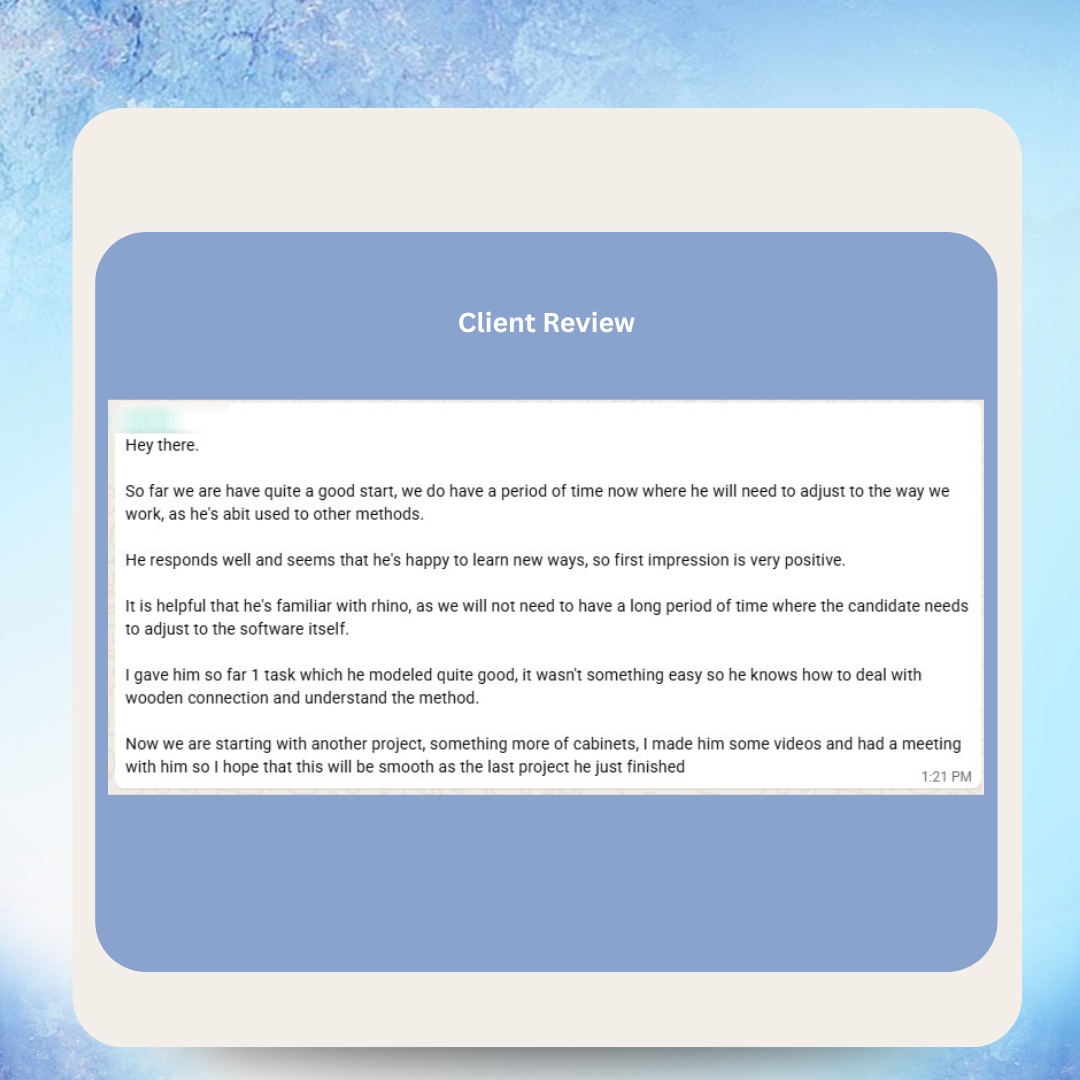
What Our Clients Say



Real Messages from Real Clients


Hear From Our VAs
The quality of results your VA delivers depends directly on how supported and motivated they feel. Our culture is built around long-term relationships — and that's reflected in performance that improves month over month, not plateaus after placement.


As Featured In





Frequently Asked Questions
What is an architectural virtual assistant?
An architectural virtual assistant is a remote professional — typically a trained architect or design technician — who supports architecture firms with production tasks (CAD drafting, Revit modeling, 3D rendering, construction documentation) and administrative tasks (RFI management, permit tracking, bid preparation, project scheduling, client communication). They work as dedicated members of your team, embedded in your workflows and software environment, at significantly lower cost than local hires.
What can an engineering virtual assistant do for my firm?
An engineering VA can handle technical drafting support (AutoCAD, Civil 3D, Revit), BIM coordination and clash detection, MEP layout drafting, submittal and RFI management, permit application coordination, project scheduling, fee proposal preparation, invoice processing, and general project administration. The specific scope depends on whether you're hiring a technical production VA or an operations/admin VA — most AEC firms benefit from one or both types.
Do Filipino VAs actually know AutoCAD and Revit?
Yes. Philippines architecture and engineering programs teach AutoCAD from the first year and Revit is standard curriculum in most accredited programs. Many Filipino AEC professionals also have hands-on project experience from working with international firms in Australia, the UK, and the US. At VA Masters, we verify software proficiency through portfolio review and practical skills tests — not just self-reported skills — before presenting any candidate.
How much does an architecture VA cost compared to hiring locally?
A Filipino architecture or engineering VA through VA Masters works at $8.50–$15 per hour — approximately $1,480–$2,600 per month full-time. A US-based junior architect costs $60,000–$85,000 annually ($5,000–$7,000/month). A CAD technician runs $50,000–$70,000/year. An AEC-specialized offshore agency typically charges $2,000–$4,000/month with less flexibility. The cost savings of a dedicated VA are approximately 70–80% versus local equivalents.
Can a virtual assistant handle MEP engineering drafting?
Yes. MEP drafting is one of the highest-demand use cases for AEC VAs. Filipino MEP drafting VAs work in Revit MEP, AutoCAD MEP, and related tools to produce HVAC layout plans, electrical circuiting, panel schedules, plumbing riser diagrams, and fire protection layouts from your engineers' designs. The VA handles production drafting; your licensed MEP engineers retain responsibility for system design and engineering judgment. This is the model used by high-performing MEP firms to dramatically increase production capacity without proportional headcount growth.
Will a virtual assistant understand US building codes?
Filipino AEC graduates have training in international building standards and many have prior experience working with US or Australian firms. Working knowledge of IBC, IRC, ADA, ASHRAE, NFPA, and NEC standards develops through project exposure and reference materials. Most VAs we place are already familiar with US code concepts at an operational level — understanding enough to produce compliant documents from your firm's marked-up instructions. Complete code mastery deepens with tenure on the job, exactly as it does for any junior hire.
What's the difference between a virtual assistant for architects and a freelance drafter?
A freelance drafter works project-by-project, charges per hour or per drawing, and has no continuity in your firm's standards, software setup, or institutional knowledge. A dedicated VA works full-time, exclusively for your firm, learns your standards, grows into your workflows, and improves continuously over time. For AEC firms with ongoing production needs, a dedicated VA consistently outperforms the freelance model because the learning investment compounds rather than resetting with each engagement.
Can a VA manage my BIM 360 or Autodesk Construction Cloud environment?
Yes. VAs experienced with BIM 360 and Autodesk Construction Cloud can manage document control, organize drawing issue transmittals, maintain revision logs, coordinate model links across disciplines, and manage project file structure. For firms using Procore or Buildertrend, VAs can maintain the RFI and submittal workflows within those platforms as well. We match based on your specific document management tools during recruitment.
How long does it take to get an architecture or engineering VA through VA Masters?
Most clients receive their top 2–3 pre-vetted candidates within 2 business days of completing our discovery call. The full process — discovery, sourcing, portfolio review, skills testing, client interviews — typically runs 7–14 business days for technical AEC roles. Technical specializations (MEP drafting, Civil 3D, structural) may take slightly longer when specific software expertise is required. We don't rush the skills testing stage — getting it right matters more than getting it fast.
What is the best virtual assistant software for architecture firms to use with a remote VA?
The best setup for architecture firms working with remote VAs combines cloud-based file collaboration (BIM 360 or Autodesk Construction Cloud for drawing management, or Dropbox/Google Drive for smaller firms), a project management tool (Asana, Monday.com, or Trello for task tracking), communication via Slack or Microsoft Teams, and Bluebeam Revu or PDF annotation for transmitting redlines. VAs can also access your desktop AutoCAD or Revit environments via VPN if required. We help set up these collaboration protocols during onboarding.
Can I hire a VA specifically for permit application support?
Yes. Permit application support is one of the most impactful uses of an operations VA for AEC firms. A VA handles: compiling drawing packages to jurisdiction-specific requirements, completing application forms, uploading to online permit portals, tracking review status, and responding to correction notices or resubmittal requests. The procedural work of permit coordination is exactly what VAs excel at — structured, detail-oriented, and time-consuming for licensed staff.
Do I need to be at a certain firm size to justify an architecture or engineering VA?
Most firms hiring their first AEC VA have 3–15 licensed staff and billing between $600K and $3M annually. This is the range where the cost of having licensed professionals doing production and administrative work is clearest. Smaller firms (1–2 principals) may benefit from a part-time VA initially, scaling to full-time as workload grows. Larger firms often hire multiple VAs — one technical and one operational — to fully separate production support from project administration.
Free Your Licensed Staff to Do What They Were Trained For
Stop paying architect and engineer rates for drafting updates, RFI tracking, and permit applications. Get a dedicated AEC virtual assistant — technically vetted, skills-tested, and supported by VA Masters' full 6-stage process.
- Custom skills test for every AutoCAD, Revit, and MEP role
- Technical portfolio review — not just self-reported software skills
- Up to 80% cost savings vs. US-based local hire
- Top 2–3 verified candidates delivered within days
- No upfront fees — pay only when you approve your hire
- SOP development, onboarding support, and replacement guarantee included