
3D Furniture Designer Virtual Assistant: Hire a Dedicated Specialist (from $8/hr)
If your furniture business, interior design studio, or manufacturing operation is outsourcing 3D modeling on a project-by-project basis, you're leaving serious money and consistency on the table. A dedicated 3D furniture designer virtual assistant doesn't just complete tasks — they learn your style, your software stack, your client preferences, and your quality standards. Then they apply that knowledge every single day.
The difference between a freelance 3D studio and a dedicated VA is the difference between a taxi and a driver. One shows up when you call. The other is already in the car, warmed up, knowing exactly where you're headed.
At VA Masters, we recruit and place pre-vetted 3D furniture design specialists from the Philippines — professionals with real software experience in Rhino, Blender, 3ds Max, SketchUp, AutoCAD, and V-Ray. Every candidate passes a custom skills test built around your actual project requirements before you ever meet them.
What Is a 3D Furniture Designer Virtual Assistant?
A 3D furniture designer virtual assistant is a remote specialist who creates, modifies, and renders three-dimensional furniture models for your business on an ongoing basis. Unlike a freelance 3D studio that handles one-off projects, a dedicated VA works exclusively with you — learning your product lines, your brand standards, and your client preferences over time.
This matters more than most business owners realize. When you use a project-based service, every new model starts from scratch: briefing the team, re-explaining your standards, waiting through revision cycles. A dedicated 3D furniture VA already knows your design language. Project turnaround drops from days to hours.
The role typically covers a spectrum of design tasks depending on your industry. Furniture manufacturers need precise technical models for production documentation. E-commerce brands need photorealistic renders for product listings. Interior design studios need client-ready visualizations that show exactly how a piece will look in a specific room. A strong 3D furniture VA can operate across all three.
The Core Distinction
A 3D modeling studio owns the pipeline. A 3D furniture VA joins yours. They work in your software, follow your naming conventions, save directly to your shared drives, and communicate in real time through your project management tools. Consistency, context, and continuity — none of which you get from a rotating pool of freelancers.
Tasks a 3D Furniture VA Handles Every Day
The scope of work depends on your business, but the most productive 3D furniture designer VAs typically manage a mix of modeling, rendering, file management, and client-ready output preparation. Here's what a typical engagement looks like across different business types.
For Furniture Manufacturers
Manufacturers need models that serve both design and production. Your VA handles conversion of 2D technical drawings, rough sketches, or reference photos into precise 3D models. They produce detailed CAD drawings with accurate dimensions, joinery details, and material specifications. They create exploded-view diagrams for assembly documentation, generate bill-of-materials-ready files, and export models in production-compatible formats like STEP, OBJ, or STL.
For E-Commerce and Retail Brands
Product listings live or die on visual quality. A 3D furniture VA creates high-resolution photorealistic renders against white backgrounds for catalog use, lifestyle renders showing pieces in styled room environments, 360-degree rotations for interactive product viewers, and AR-compatible models for augmented reality shopping experiences. They also handle bulk variations — different finishes, fabrics, and color options rendered from a single base model.
For Interior Designers and Architects
Client presentations are your competitive advantage. Your VA builds room scenes populated with custom furniture models, renders lighting variations to show how a piece performs in different conditions, creates top-down floor plan overlays, and exports high-resolution presentation boards. When clients request modifications — a different leg finish, adjusted dimensions, a new upholstery option — your VA turns those around fast instead of waiting days for a studio callback.
For 3D Studios and Design Agencies
Many studios outsource their furniture modeling backlog to a dedicated VA who handles FF+E (Furniture, Fixtures & Equipment) modeling specifically. This frees your senior artists for complex scene work and creative direction while your VA processes the repetitive but critical modeling tasks that would otherwise bottleneck every project.
What "Full-Service" Actually Looks Like
One of our clients — a furniture manufacturer working across residential and hospitality sectors — has a VA who handles everything from raw sketch conversion to final production files. The client sends rough drawings via WhatsApp. The VA models in Rhino, tests joinery, creates renders in V-Ray, and drops the finished files into the shared drive before the end of the shift. No studio briefing, no quote requests, no waiting on approvals. Just a consistent workflow that compounds over time.
See How VA Masters Recruits and Tests Specialists
Software Skills to Look For in a 3D Furniture Designer VA
Software proficiency is non-negotiable in 3D furniture design. The tools your VA uses directly affect file compatibility with your production team, render quality for your clients, and turnaround speed on revisions. Here's what experienced 3D furniture VAs typically bring to the table — and what you should ask about in the hiring process.
Modeling Software
| Software | Best For | Common in Furniture Industry? |
|---|---|---|
| Rhino 3D | Complex curves, precision modeling, woodworking details | Yes — especially high-end furniture and joinery |
| Blender | Organic forms, rendering, animation, free/open source | Yes — growing rapidly, especially for e-commerce |
| Autodesk 3ds Max | Product visualization, interior scenes, photorealistic renders | Yes — industry standard for furniture visualization |
| SketchUp | Quick modeling, architectural context, interior design | Yes — widely used by interior designers and architects |
| AutoCAD / AutoCAD Furniture | Technical drawings, 2D plans, production documentation | Yes — production and manufacturing workflows |
| SolidWorks / Fusion 360 | Engineering-grade models, CNC/machining output | Specialized — custom and industrial furniture manufacturers |
Rendering Software
A great model is only half the job. Your VA also needs to produce renders that actually sell furniture. Key rendering tools include V-Ray (the industry standard for photorealism), Lumion (fast, popular in architectural visualization), Corona Renderer, Enscape (real-time rendering in SketchUp and Revit), and KeyShot for product photography-style renders. When reviewing candidates, ask them to show renders they've produced — not just models.
File Format Fluency
Your VA needs to work fluently across file formats: delivering OBJ and FBX for game engines and AR platforms, STEP and IGES for manufacturing, STL for 3D printing prototypes, and high-resolution TIFF or PNG renders for marketing. They should also be comfortable with 3D model optimization — reducing polygon counts for web and AR use without sacrificing visual quality.
VA Masters Skills Test Note: When recruiting 3D furniture design VAs, we build a custom skills test around the client's actual software requirements. A candidate applying for a Rhino + V-Ray role gets a real modeling task in those tools — not a generic design quiz. This is how we know who can actually do the work before you invest any time in interviews.
Types of Furniture Projects a VA Can Support
The scope of 3D furniture modeling is broader than most people initially think. A skilled VA can handle multiple furniture categories depending on their background, and many Filipino specialists have experience across several sectors simultaneously.
Residential Furniture
The largest category by volume, residential furniture modeling covers sofas, armchairs, beds, dining tables, bedroom sets, kitchen cabinetry, shelving units, garden furniture, and children's pieces. E-commerce brands selling residential furniture benefit most from high-volume rendering capacity — generating multiple finish variations, lifestyle shots, and 360-degree views efficiently. A dedicated VA handles this pipeline continuously rather than in periodic batches.
Commercial and Office Furniture
Office chairs, workstations, height-adjustable desks, conference tables, storage solutions, and modular workspace systems all require precise modeling for corporate sales presentations, catalog production, and space planning. Commercial furniture manufacturers often need CAD drawings alongside visual renders, as the same model serves both sales and production teams.
Hospitality and Contract Furniture
Hotels, restaurants, retail environments, and healthcare facilities require furniture that meets strict dimensional and durability specifications. Hospitality furniture modeling often involves complex upholstery details, custom fabric mapping, and integration with architectural visualization. Your VA can create room scenes showing furniture in context — a critical selling tool for hospitality clients who need to visualize a complete environment rather than individual pieces.
Custom and Bespoke Furniture
Custom furniture makers need VAs who can work from rough client sketches, napkin drawings, or reference images and produce proposal-quality renders before a single piece of timber is cut. This requires strong spatial reasoning, the ability to interpret loose briefs, and confidence in making design decisions within established aesthetic parameters. These are the most skilled candidates — and VA Masters has placed them for high-end furniture ateliers across the US, UK, and Australia.
Outdoor and Garden Furniture
Outdoor furniture modeling requires attention to material textures — rattan weaves, powder-coated metal, treated timber — and convincing environmental contexts. Renders showing pieces in realistic garden settings dramatically outperform pure white-background shots for consumer conversion. A skilled VA manages both the modeling and the environmental rendering.
Dedicated 3D Furniture VA vs. Project-Based 3D Studio
This is the central decision most furniture businesses face. Both options have legitimate use cases, but understanding the tradeoffs helps you choose the right model for your operation.
Project-Based 3D Studio
- Re-briefing required for every project
- Inconsistent quality between projects and team members
- Per-project pricing escalates with volume
- No institutional knowledge of your products or brand
- Communication delays across time zones and ticket queues
- You can't prioritize urgent requests above their queue
- No integration with your project management tools
- No ongoing quality improvement as they learn your standards
Dedicated 3D Furniture VA (via VA Masters)
- Knows your entire product library and brand standards
- Consistent output improves over time as they learn your preferences
- Flat hourly rate — volume costs nothing extra
- Builds institutional knowledge of your catalog, clients, and workflow
- Works your hours, responds in real time
- Your priority is their only priority
- Fully integrated into your tools: drive, PM software, communication channels
- Performance improves week over week — not starting from zero each time
The math is also straightforward. A mid-level 3D studio charges $25–$60 per render for standard furniture shots, and significantly more for complex lifestyle scenes. A dedicated 3D furniture VA from the Philippines costs $8–$14 per hour — and in that hour can produce multiple renders, modifications, or technical drawings. The economics flip entirely once you have consistent monthly volume.
What Does a 3D Furniture Designer Virtual Assistant Cost?
Hiring a 3D furniture designer VA through VA Masters falls under our Design & Creative Arts category. Rates reflect real-world skill levels and are structured to deliver maximum value while ensuring fair compensation for high-quality Filipino talent.
For context, a full-time 3D furniture designer VA working 40 hours per week costs roughly $1,280–$2,240 per month. Compare that to the US equivalent — a junior to mid-level 3D artist in the United States earns $50,000–$80,000 annually, or $4,200–$6,700 per month. You're looking at up to 80% in labor cost savings while accessing the same level of technical skill.
What Determines Where a Candidate Falls in the Range?
The lower end of the range represents candidates with 2–3 years of experience and strong proficiency in one or two core tools. The higher end covers specialists with 5+ years of experience, advanced rendering skills, multiple software platforms, and a proven track record with international clients. For complex custom furniture, manufacturing-grade CAD work, or senior-level visualization roles, the $12–$14 range delivers exceptional value.
Avoid the Race to the Bottom
Platforms like Upwork and Fiverr list 3D furniture designers from $3–$5 per hour. These are almost always newer graduates with limited real-world project experience and no dedicated attention to your work. Quality 3D furniture design requires deep software proficiency, strong spatial reasoning, and genuine design sensibility — skills that take years to develop. VA Masters focuses on the $8–$14 range because that's where reliable, high-quality professionals actually live. Saving $200/month on a VA who delivers mediocre renders costs you far more in client trust and revision time.

Hiring Lawrence as a QuickBooks Expert and Lery as a Real Estate Administrative VA through VA Masters has completely transformed how I run my property operations. The cost savings compared to local hires are substantial — and the quality hasn't dropped by a single percentage point. I wish I'd made this move years earlier.
What to Look For When Hiring a 3D Furniture Designer VA
Most hiring mistakes happen because businesses evaluate 3D furniture VAs on credentials rather than actual demonstrated output. A degree in industrial design or architecture means little if the candidate can't produce clean Rhino models or deliver photorealistic renders under deadline pressure. Here's what actually matters.
Portfolio Over Resume
Ask for a portfolio that matches your specific needs. If you manufacture solid wood bedroom furniture, ask to see models of complex joinery, accurate grain textures, and realistic lighting in bedroom contexts. If you sell contract seating, look for clean technical models with accurate upholstery simulation. A strong portfolio demonstrates what a candidate has already done — not what they claim they can learn.
Software Depth, Not Just Breadth
Many candidates list six software tools on their resume. Ask them to rate their confidence in each from 1–10 and describe the most complex project they've completed in their top two. You want depth in the tools you actually use, not a shallow familiarity with everything. Someone who is genuinely expert in Blender and V-Ray will outperform a generalist who dabbles in five platforms.
File Format Literacy
Ask directly: "If I send you a 2D DWG drawing and a reference photo, what files would you deliver, and in what formats?" A strong candidate immediately walks you through their workflow — how they interpret the brief, what decisions they make, what they'd clarify before starting, and what the final package looks like. Vague answers reveal a gap between claimed and actual skill.
Revision and Feedback Response
3D furniture work involves constant revision. Dimensions change, finishes evolve, clients request modifications at the last minute. How a VA handles feedback is at least as important as the quality of their first pass. In interviews, ask about a time they received unexpected last-minute feedback on a project and how they responded. Look for calm problem-solving, not frustration.
Communication in English
Filipino VAs have a strong advantage in international work — English is an official language of the Philippines, taught from kindergarten, and widely used in professional contexts. Still, the quality of professional communication varies. Listen for clarity, proactive updates, and the ability to ask precise clarifying questions rather than making assumptions that lead to rework.
How VA Masters Recruits and Tests 3D Furniture Design Specialists
Every 3D furniture designer we place has cleared a 6-stage recruitment process built around your specific requirements — not a generic design assessment. Here's exactly what that looks like.
Detailed Role Definition
We start with a conversation about your software stack, project types, volume, deadline expectations, and quality benchmarks. We don't post a generic "3D designer" job — we post your specific role, attracting candidates who match your actual requirements.
Candidate Collection
We source from 1,000+ applicants across targeted job platforms, our internal talent network, and direct outreach to candidates with relevant furniture design backgrounds. The initial pool is filtered immediately for software match and portfolio quality.
Initial Screening
Portfolio review, experience verification, and English communication assessment. We narrow the field to candidates who meet your software requirements and can demonstrate relevant project history — typically around 50–100 proceed to testing.
Custom Skills Test
This is where most agencies stop pretending. We build a real-world task in your actual software. A Rhino candidate might receive a sketch and a set of dimensions and be asked to deliver a clean model with specified joinery. A Blender candidate produces a photorealistic render against a brief. No generic quizzes — actual work.
In-Depth Interview
We assess technical depth, revision handling, communication style, and work ethic. We simulate feedback scenarios. We ask candidates to walk through their workflow on a complex task. Typically 15–20 candidates pass to this stage.
Client Interview
You meet 1–3 finalists who have already proven they can do the job. Your interview is about fit, workflow compatibility, and choosing the person you want in your creative process — not testing skills we've already verified.
Ready to Hire a 3D Furniture Designer VA?
Tell us your software requirements and project volume. We'll handle the entire recruitment process — delivering 1–3 pre-tested candidates within days.
Start the Conversation →CAD Virtual Assistants: What They Can Do Beyond 3D Modeling
One of the most underutilized capabilities of a skilled 3D furniture VA is their ability to function as a full CAD support specialist — not just a modeler. Depending on their background, a strong candidate can handle a range of technical and creative tasks that support your entire design and production workflow.
Technical Drawing and Documentation
Many furniture manufacturers spend significant time creating production documentation: dimensioned drawings, section details, assembly diagrams, and finish schedules. A CAD-experienced VA can take your approved 3D models and generate complete technical drawing packages in AutoCAD or similar tools — freeing your senior designers for creative work while the documentation gets done in parallel.
Material and Finish Libraries
Managing hundreds of material options across a product catalog is genuinely time-consuming. A dedicated VA builds and maintains your material libraries in your rendering software — creating accurate texture maps for every fabric, timber, stone, or metal option. When a client requests "the sofa in the Dove Grey bouclé," the render is ready in minutes rather than hours.
Product Catalog Management
E-commerce furniture brands need consistent, well-organized 3D asset libraries. Your VA creates naming conventions, organizes files by product line, maintains version control, and ensures that assets are exported in the right formats for every platform — from your website to third-party marketplaces to augmented reality apps.
Client Presentation Preparation
Interior designers and architects frequently need presentation-ready visualizations assembled from existing models. Your VA takes approved furniture pieces, places them in client-specific room contexts, adjusts lighting and camera angles, and produces presentation boards to your studio's visual standards — turning around client review packages that previously took days in hours.
The Compound Value of a Dedicated VA
After 3 months with a dedicated 3D furniture VA, you don't just have a modeler — you have someone who understands your entire visual language. They know which camera angles you prefer, how your clients respond to lighting variations, which wood grains render most convincingly, and when to flag a brief that needs clarification. This institutional knowledge is impossible to replicate with project-based outsourcing, and it compounds in value every week they're with your business.
Real Results: A 3D Furniture Designer VA in Action
The most compelling evidence for a VA placement isn't a case study written months later — it's the actual messages exchanged between a client and their VA during the working relationship. Here's what that looks like with a furniture design placement we made for a client working in custom wooden furniture and cabinetry.
Real Messages from Real Clients
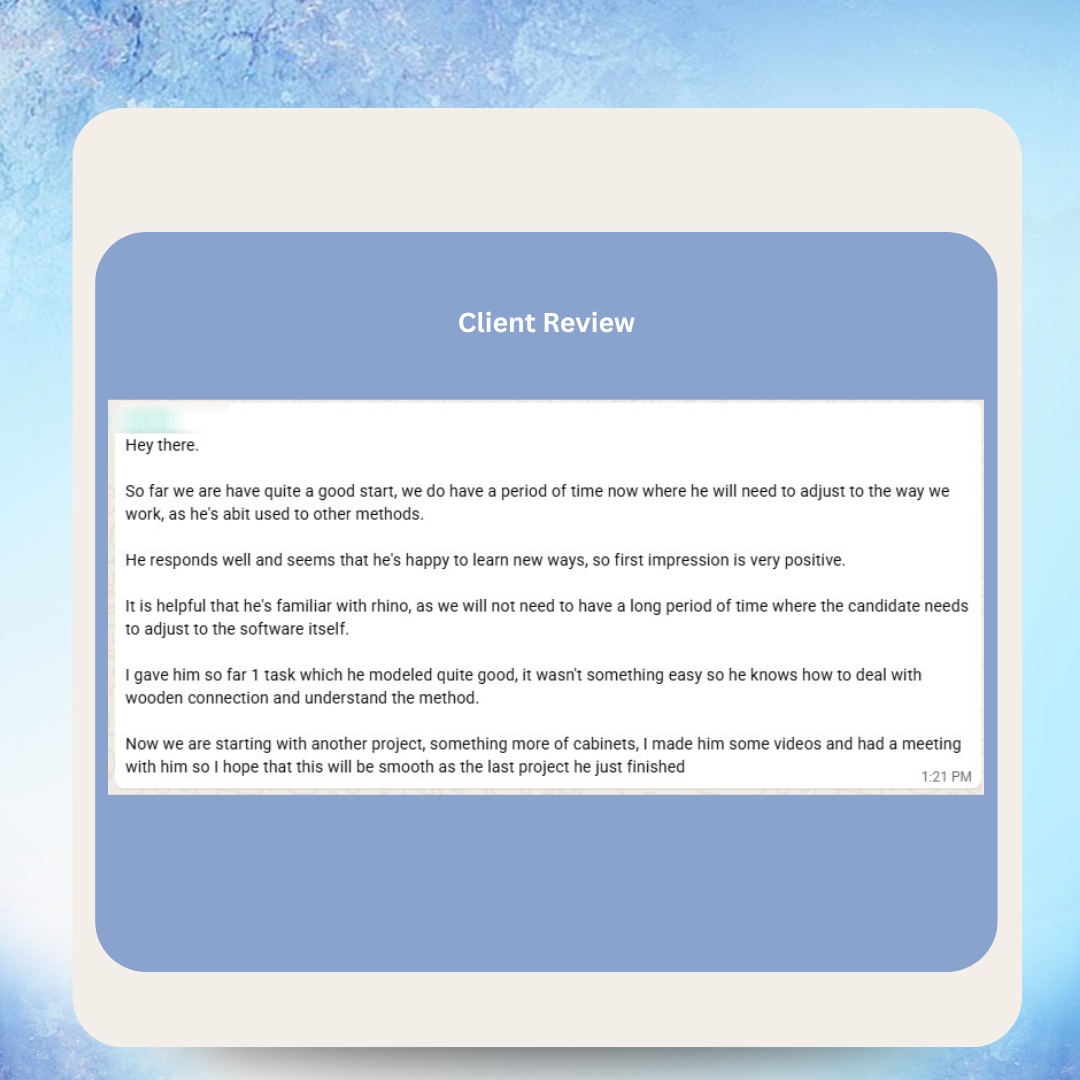


Notice what the client says about the furniture VA above: the VA is familiar with Rhino, modeled a complex wooden connection accurately on the first task, and is already being considered as someone who could train future team members. That's the result of recruiting someone who not only knows the software but understands furniture construction — not just digital geometry.
VA Masters vs. Other Hiring Options
| Feature | VA Masters | Freelance Platforms (Upwork/Fiverr) | 3D Studio (Project-Based) | In-House Hire |
|---|---|---|---|---|
| Dedicated full-time attention | ✓ | ✗ | ✗ | ✓ |
| Custom skills test before hiring | ✓ | ✗ | Partial | Rarely |
| Vetted from 1,000+ applicants | ✓ | ✗ | ✗ | ✗ |
| Up to 80% cost savings vs. local | ✓ | Variable | No — per-project fees scale | ✗ |
| Ongoing HR support and replacement guarantee | ✓ | ✗ | ✗ | ✗ |
| Risk-free start — no upfront fees | ✓ | ✗ | ✗ | ✗ |
| Institutional knowledge grows over time | ✓ | ✗ | ✗ | ✓ |
| Works your timezone and schedule | ✓ | Variable | ✗ | ✓ |
What Our Clients Say About Working With VA Masters



The People Who'll Be Working For You
Happy, supported VAs deliver better work for your business. Here's what life looks like on our team.



As Featured In





Frequently Asked Questions
What software should a 3D furniture designer VA know?
The most in-demand software for furniture design VAs includes Rhino 3D (for precision modeling and complex curves), Blender (for photorealistic rendering and organic forms), Autodesk 3ds Max (for furniture visualization and interior scenes), SketchUp (widely used by interior designers), and AutoCAD (for technical drawings and production documentation). Rendering-wise, V-Ray, Corona Renderer, and Lumion are the most requested tools. When you engage VA Masters, tell us your exact software requirements and we'll build the skills test around them.
How is a 3D furniture VA different from outsourcing to a 3D studio?
A 3D studio works on a project-by-project basis — you brief them each time, they deliver, and the relationship ends. A dedicated 3D furniture VA works exclusively for you, learning your design language, building familiarity with your product catalog, and integrating into your daily workflow. Over time they become faster, more accurate, and more valuable. They work your hours, use your tools, and build institutional knowledge you can't replicate with a rotating studio relationship.
Can a Filipino VA really handle complex 3D furniture modeling?
Yes. The Philippines produces thousands of architecture, engineering, and design graduates annually, and many specialize in 3D modeling and visualization for international markets. English is an official language in the Philippines, which eliminates the communication barriers common with other offshore markets. VA Masters has successfully placed 3D furniture design specialists with custom woodworking clients, e-commerce brands, hospitality furniture manufacturers, and interior design studios. We verify software proficiency with real skills tests before any candidate is presented to you.
What does a 3D furniture designer VA cost through VA Masters?
Rates for 3D furniture designer VAs fall in our Design & Creative Arts category: $8.00–$14.00 per hour. The specific rate depends on experience level, software depth, and the complexity of your requirements. A full-time VA at $10/hour costs approximately $1,600 per month — compared to $4,200–$6,700 monthly for an equivalent local hire in most Western markets. There are no upfront fees or recruitment charges. You only commit to an arrangement after meeting and approving a candidate.
How long does it take to hire a 3D furniture designer VA through VA Masters?
VA Masters typically delivers candidates within 2 business days of completing the role definition call. Our 6-stage process runs concurrently across all stages, so by the time you're ready to interview, candidates have already passed screening, skills testing, and in-depth evaluation. You meet 1–3 finalists who have already proven they can do the job — your interview is about fit, not assessment.
What file formats can a 3D furniture VA work with?
Experienced 3D furniture VAs handle a full range of formats: OBJ, FBX, and GLTF for digital applications and AR; STEP and IGES for manufacturing and CAD exchange; STL for 3D printing; DWG and DXF for AutoCAD documentation; and high-resolution PNG, TIFF, and JPEG for renders. When briefing candidates, specify the formats your production workflow requires and confirm compatibility during the skills test phase.
Can a 3D furniture VA work with my CAD team or production department?
Yes. Many of our placed 3D furniture VAs work as part of broader design and production teams — handling specific stages of the pipeline while collaborating with architects, product designers, and manufacturers. They can work within shared project management tools (Asana, Monday.com, ClickUp), communicate through Slack or Teams, and deliver files via shared drives. The integration into your existing workflow is part of the onboarding process we help structure.
What if the 3D furniture VA doesn't meet expectations?
VA Masters provides a replacement guarantee. If a placed VA isn't performing as expected, we re-engage our recruitment process at no additional charge and present a replacement candidate. We also provide ongoing HR support throughout the engagement — monthly check-ins, performance review support, and direct communication with your VA to address any issues before they become problems. This ongoing relationship is one of the core differences between VA Masters and a standard freelance platform.
Do I need to provide equipment or software licenses?
Typically, yes — just as you would for any employee. If your VA needs access to licensed software (like Rhino or 3ds Max), you'd provide or fund a license as part of the working arrangement. Many candidates also have their own existing licenses, particularly for Blender (free and open source) and SketchUp (widely available). This can be discussed and confirmed during the onboarding call before the VA starts.
Can a 3D furniture VA also handle 3D furniture modeling for outsource services like photography replacement?
Yes. One of the most common use cases is replacing traditional product photography with 3D renders — particularly for e-commerce brands that need multiple finish variations, room scene shots, and 360-degree views without the cost of physical photoshoots. A skilled furniture VA can produce white-background renders, lifestyle environments, and color variant banks from a single base model, dramatically reducing your per-image cost compared to studio photography.
Is outsourcing 3D furniture modeling services to a VA reliable long-term?
Consistently, yes — with the right recruitment approach. The challenge with most outsourcing arrangements is inconsistency: different people, different quality, no continuity. A dedicated VA placed by VA Masters becomes a long-term team member. Our clients regularly maintain VA relationships for 2–4 years. The longer the relationship, the more embedded the VA becomes in your workflow — and the higher the quality and speed of their output. This is the model that actually works.
What industries typically hire 3D furniture designer VAs?
The most common are: furniture manufacturers needing production documentation and marketing renders; e-commerce furniture brands requiring product listing imagery at scale; interior design studios producing client presentations; hospitality and contract furniture brands selling to hotels and commercial clients; custom furniture makers needing proposal visualizations; and 3D visualization studios outsourcing FF+E modeling work. The common thread is ongoing, repeatable volume — the kind of work that benefits from a dedicated specialist rather than one-off project outsourcing.
Hire a Dedicated 3D Furniture Designer VA — Risk-Free
Stop re-briefing studios on every project. Get a dedicated 3D furniture specialist who learns your workflow, masters your standards, and delivers consistent quality every day.
- Software-tested candidates in Rhino, Blender, 3ds Max, SketchUp, AutoCAD
- $8–$14/hr — up to 80% less than local hiring
- No recruitment fees. No upfront payment. No risk.
- Candidates delivered within 2 business days
- Replacement guarantee if it's ever not the right fit